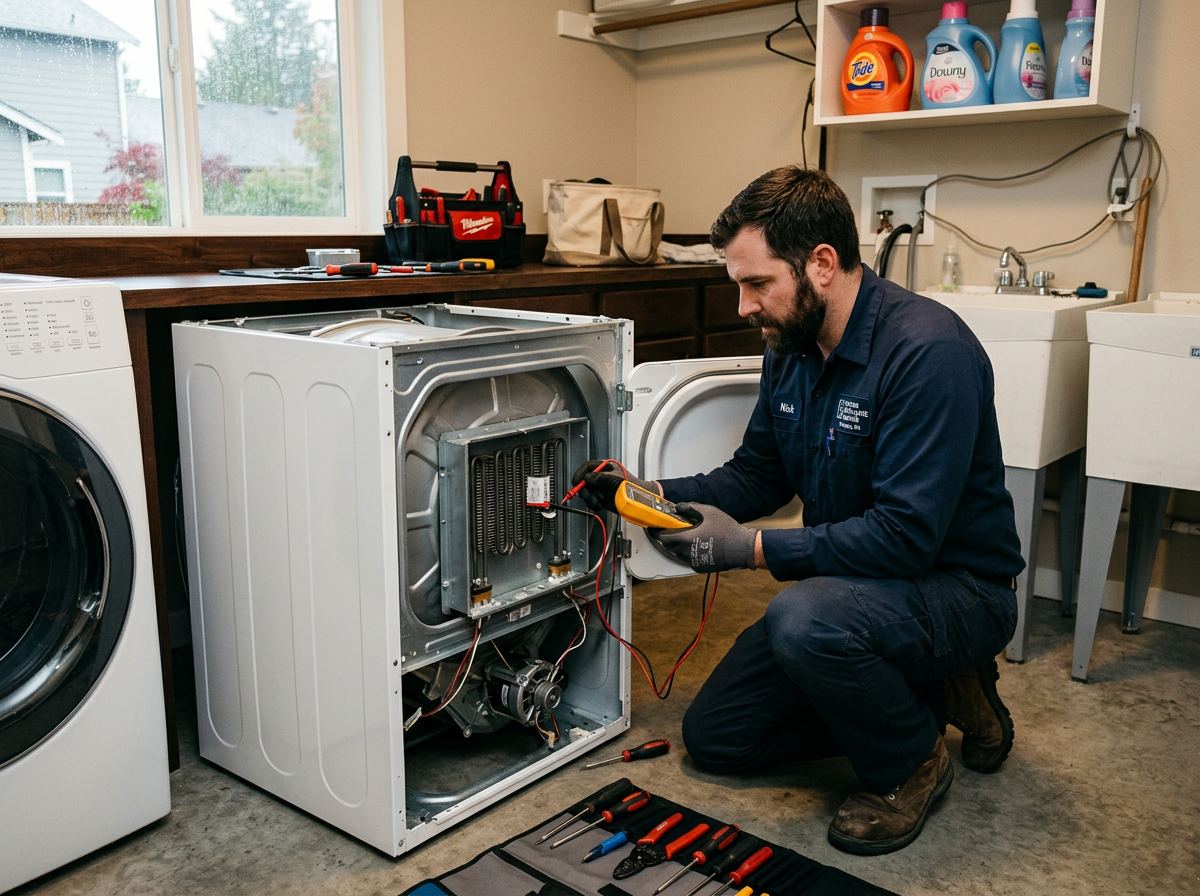
Puyallup’s frequent rain and mild oceanic climate push moisture into dryer vents faster than in drier regions, especially on older homes built before 1990 in the Valley and Summit neighborhoods. Lint mixes with that damp air and creates blockages that trip the high-limit thermostat or blow the thermal fuse, leaving the heating element cold even when it tests good. Homes near the Puyallup River or Meeker Mansion often have longer or poorly sloped vent runs that trap water, so technicians check the entire run to the exterior wall rather than stopping at the machine.
Electric dryers dominate South Hill and Downtown Puyallup housing stock, but gas models appear more often in Sumner and Bonney Lake properties. When a gas dryer fails to heat, the igniter, flame sensor, or gas valve coil usually fails first; these parts sit behind the front panel and require removing the drum for safe access. Technicians also verify 240-volt supply at the outlet because low voltage from aging wiring in Pierce County homes can mimic a failed element.
Before any part swap, the vent is disconnected and run through a powered brush to clear compacted lint and rainwater residue. This step alone restores heat on roughly one-third of calls because restricted airflow overheats the safety devices. After reassembly, airflow is measured at the exterior vent hood to confirm at least 1,200 feet per minute before the machine is returned to service.
Technician insight
In Puyallup, the thing that catches most people out with Dryer Not Heating is the rain-soaked lint that packs into the horizontal vent runs common on South Hill split-levels. Homeowners keep replacing the element while the real restriction sits two elbows downstream, so the new part fails again within weeks.
South Hill Split-Level, Dryer Runs But No Heat
The homeowner reported the dryer tumbling with no warmth for two weeks. We found the thermal fuse open and the vent hose collapsed under the house where it crossed the crawlspace. After replacing the fuse and re-running the vent with proper slope and a new exterior hood, the dryer produced steady heat and the airflow reading returned to normal.
Dryer Not Heating Services We Offer
✓Electric Heating Element Replacement
Remove the rear panel, test resistance across the element, and install a new OEM coil when open circuits are found.
✓Thermal Fuse and Thermostat Testing
Check continuity on the thermal fuse, high-limit thermostat, and operating thermostat to isolate the exact safety device that opened.
✓Gas Igniter and Flame Sensor Service
Replace the silicon carbide igniter and clean the flame sensor on gas models that fail to ignite after the dryer tumbles.
✓Exhaust Vent Clearing for Heat Loss
Disconnect and brush the full vent run from dryer to exterior wall, removing wet lint that restricts airflow and trips safety switches.
✓Moisture Sensor and Control Board Check
Test the moisture sensor bars and inspect the main control board for error codes that prevent the heating circuit from energizing.
How it works
- 1
Initial Diagnosis
Plug in a test meter at the outlet, confirm 240 volts, then run the dryer on a timed heat cycle while monitoring amp draw.
- 2
Component Isolation
Remove the top and front panels, test the heating element, thermal fuse, and thermostats for continuity without guessing.
- 3
Vent Inspection
Disconnect the vent hose, run a powered brush through the line, and verify clear exit at the exterior hood.
- 4
Repair And Verification
Install needed parts, reassemble, and confirm restored heat plus proper airflow before leaving the home.
Pricing
Clear quote after diagnosis; most dryer-not-heating calls fall between a vent clearing and a single-part swap.